
Voice AI has come a long way in recent years, but despite massive improvements in speech recognition and text generation, one major problem has persisted: natural conversation. Most voice assistants still feel robotic, slow, and rigid. They wait for you to finish speaking, pause awkwardly, then respond in a way that feels disconnected from real human dialogue.
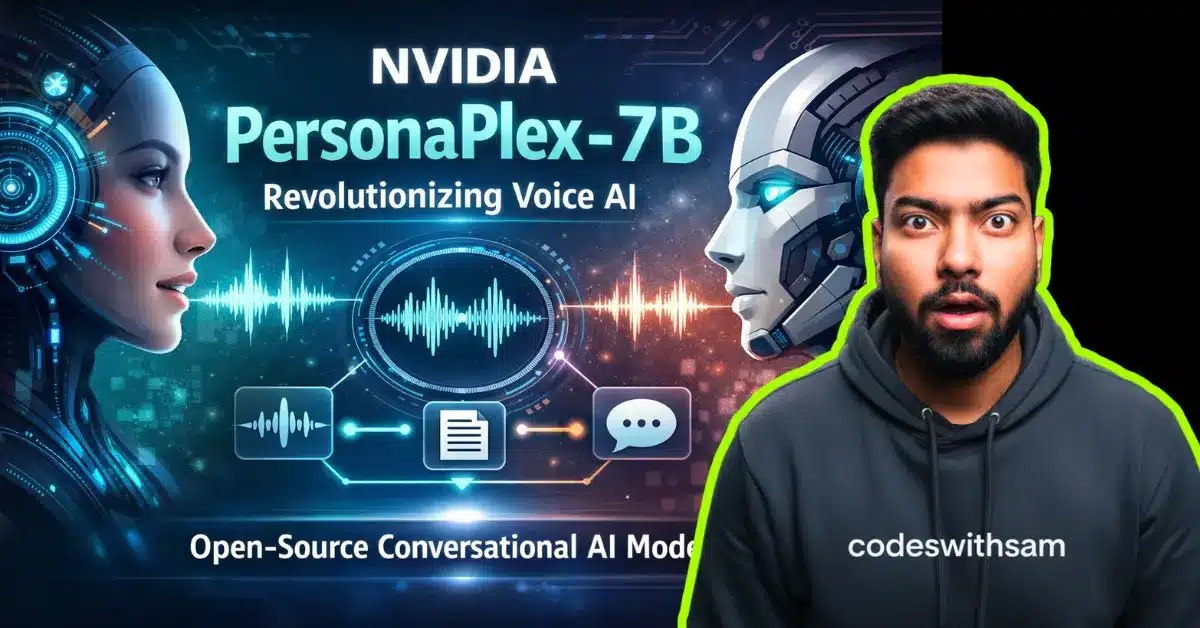
| Article Name | NVIDIA PersonaPlex-7B: The Breakthrough That Makes Voice AI Feel Human |
| Publish Date | 29/1/2026 |
| News | Nvidia AI Voice |
| Ai Name | Nvidia |
| Author | Codeswithsam |
NVIDIA has introduced PersonaPlex-7B, an open-source conversational AI model designed to listen and speak at the same time. This release marks a significant shift in how voice AI systems are built—and how humans interact with them.
In this article, we’ll break down what PersonaPlex-7B is, how it works, why it matters, and what it means for the future of voice AI development.
What Is NVIDIA PersonaPlex-7B?
PersonaPlex-7B is a 7-billion-parameter open-source conversational model released by NVIDIA under the MIT license. The model’s weights are publicly available on Hugging Face, making it free to use, modify, and deploy—even for commercial projects.
What makes PersonaPlex-7B unique isn’t just its size or open nature. It’s the way the model handles audio and text simultaneously, enabling real-time conversational interaction that feels far more human than traditional voice systems.
Unlike older architectures, PersonaPlex-7B doesn’t treat listening and speaking as separate stages. Instead, it processes continuous audio tokens and generates responses in parallel.
Did Stranger Things Season 5 Use ChatGPT?
The Problem With Traditional Voice AI Pipelines
Most existing voice assistants rely on a three-step pipeline:
- ASR (Automatic Speech Recognition) – Converts speech to text
- LLM (Large Language Model) – Processes the text and decides a response
- TTS (Text-to-Speech) – Converts the response back into audio
While this approach works, it introduces several limitations:
- Delayed responses
- Awkward pauses
- No real interruptions
- No back-channel signals like “uh-huh” or “I see”
- Conversations feel transactional, not natural
Each component must finish its task before passing control to the next. As a result, voice interactions feel more like turn-based commands than fluid dialogue.
How PersonaPlex-7B Works Differently
PersonaPlex-7B uses a dual-stream transformer architecture that processes audio and text in parallel. Instead of waiting for speech to end, the model continuously listens and generates output at the same time. Audio tokens flow into the model while response tokens flow out—creating a seamless conversational loop.
Key Technical Innovations
- Continuous audio token processing
- Parallel text and speech generation
- Single unified model instead of separate ASR, LLM, and TTS systems
- Low-latency conversational flow
This design enables behaviors that were previously extremely difficult or impossible to achieve in voice AI.
Open-Source, MIT Licensed, and Developer-Friendly
One of the most important aspects of PersonaPlex-7B is its open-source release.
Why This Matters for Developers
- MIT license allows commercial use
- Open weights on Hugging Face
- Easy experimentation and fine-tuning
- No vendor lock-in
- Ideal for research, startups, and indie developers
For developers building voice assistants, chatbots, virtual agents, or accessibility tools, PersonaPlex-7B provides a powerful foundation without restrictive licensing.
Potential Use Cases for PersonaPlex-7B
The ability to listen and speak simultaneously unlocks a wide range of applications.
Voice Assistants
Smarter assistants that feel conversational instead of command-based.
Customer Support Bots
AI agents that can respond naturally, interrupt politely, and acknowledge users in real time.
Gaming and Virtual Worlds
NPCs that talk like humans, react instantly, and adapt mid-conversation.
Accessibility Tools
Real-time conversational assistants for users with speech or motor impairments.
AI Companions
More engaging and emotionally responsive AI companions that feel less artificial.
Why This Is a Big Moment for Voice AI
For years, the biggest limitation in voice AI wasn’t intelligence—it was interaction quality. PersonaPlex-7B tackles the problem at its root by redesigning the architecture itself instead of stacking more tools on top of a broken pipeline.
This release signals a shift toward:
- Unified multimodal models
- Real-time interaction
- More human-like AI behavior
It also sets a new benchmark for open-source conversational AI
Final Thoughts
NVIDIA PersonaPlex-7B isn’t just another language model—it’s a fundamental rethink of how voice AI should work.
By removing the rigid ASR → LLM → TTS pipeline and enabling simultaneous listening and speaking, NVIDIA has eliminated one of the biggest friction points in conversational AI. For developers, researchers, and AI enthusiasts, this is an exciting step toward voice systems that finally sound—and feel—human. If you’re building the next generation of voice applications, PersonaPlex-7B is a model worth paying attention to.
And for more deep dives into cutting-edge AI, development tutorials, and tech insights, keep exploring codeswithsam.com
Important Links
| Our Website | Codeswithsam.com |
| Join Telegram | Click Here |
If we made a mistake or any confusion, please drop a comment to reply or help you in easy learning.
Thanks! 🙏 for visiting Codeswithsam.com ! Join telegram (link available in bottom) for source code files , pdf and
Any Promotion queries 👇
info@codeswithsam.com

